


Bulgarian Folklore: Magic Myths Legends and Their Lasting Cultural Power
Updated: 2 days ago
A winter night in the Bulgarian mountains can feel crowded, even when no one is there. The wind moves through the pines, a dog barks from a distant yard, and old stories seem to gather at the edge of the firelight. In Bulgarian folklore, the world is never only what the eye sees. Forests have spirits. Rivers listen. Spring arrives with a red-and-white thread. Evil can be frightened away by bells, masks, and dance.
That sense of hidden life gives Bulgarian tradition its power. Folklore is not a museum piece in Bulgaria. It lives in songs, costumes, village festivals, family customs, literature, and contemporary art. It carries memory from Thracian, Slavic, and Christian worlds, shaped over centuries by mountain villages, farming cycles, and regional pride.
Bulgarian Folklore Magic Myths Legends and Their Lasting Cultural Power is more than a poetic phrase. It describes a living inheritance, one that still helps Bulgarians tell stories about courage, beauty, danger, love, and belonging.

Bulgarian folklore sees magic as part of daily life
Bulgarian folklore does not separate the magical from the practical. Magic appears in the tasks of ordinary life, in sowing fields, baking ritual bread, guarding a newborn, honoring the dead, and marking the change of seasons.
Many old beliefs come from a world where survival depended on nature. A storm could destroy crops. A harsh winter could threaten livestock. Illness, drought, and bad luck needed explanation, and folklore gave people a language for unseen forces.
That language often took shape through ritual. A family might place charms near a crib, tie red thread for protection, or follow strict customs on certain feast days. These actions were not random superstition. They created order in uncertain times.
Some of the most familiar magical ideas include:
Protective colors
Red often guards against evil, illness, and the “evil eye.”
Thresholds and crossroads
Doorways, bridges, crossroads, and village borders often mark places where danger and wonder meet.
Ritual bread
Decorated bread appears at weddings, Christmas, funerals, and seasonal rites. Its shapes can symbolize the sun, animals, fertility, or family unity.
Song as power
Folk songs preserve history, but they also act as blessing, mourning, praise, warning, and spell.
The result is a worldview where every object can hold meaning. A thread, a bell, a loaf of bread, or a sprig of geranium can become a bridge between the visible and invisible.
Myths and legends fill the mountains, fields, and rivers
Bulgarian folklore is rich because it draws from different layers of history. Ancient Thracian beliefs, Slavic mythic figures, Christian saints, and local village tales often blend together. A mountain may be tied to an old pagan spirit and a Christian feast day at the same time.
This blending makes the stories feel deep and flexible. They can change from one region to another while keeping their core meaning.
Samodivi are beautiful and dangerous forest spirits
The samodivi, also called samovili in some traditions, are among the most striking figures in Bulgarian folklore. They are usually described as wild female spirits who live in forests, mountains, or near water. They dance at night in secret clearings, wear white garments, and possess otherworldly beauty.
Yet their beauty is dangerous. A person who stumbles into their dance may be enchanted, punished, or even killed. In some stories, a hero steals a samodiva’s garment or veil, which gives him power over her. In others, a samodiva helps a warrior, heals the sick, or becomes the mysterious bride of a mortal man.
The samodivi reveal a common pattern in folklore. Nature is not evil, but it demands respect. Beauty can bless or destroy. The forest gives shelter, but it also has its own laws.
Zmeys and lamias bring desire, storms, and chaos
Bulgarian tales often feature powerful dragon-like beings. A zmey can appear as a winged serpent, a fiery creature, or a handsome young man. In some regions, the zmey protects villages from destructive storms. In love stories, it may fall for a human woman and visit her in secret.
The lamia and hala are darker beings, often linked with drought, storms, or greed. They may block water, steal fertility from the land, or threaten entire villages. Heroes fight them to restore balance.
These dragon figures do more than entertain. They turn weather, hunger, and desire into characters that can be faced. When a hero defeats a lamia, the story gives shape to hope. Chaos can be named. Fear can be fought.
Karakondzhuli haunt the dangerous days of winter
The karakondzhul is a mischievous or frightening creature associated with the coldest, darkest part of the year. It appears in Balkan folklore more broadly, with Bulgarian versions often placing it during the so-called “dirty days” between Christmas and Epiphany.
Stories describe karakondzhuli as hairy, strange, night-roaming beings that trouble people who wander after dark. They belong to a season when the old year has ended but the new one has not fully settled.
Their role is clear. They warn people to respect sacred time, stay close to home, and follow ritual rules until order returns.
Rituals turn folklore into living practice
Stories are only one part of Bulgarian folklore. Rituals give those stories bodies, sounds, colors, and movement. They make belief public. They also bring communities together across generations.
Baba Marta brings spring through red and white thread
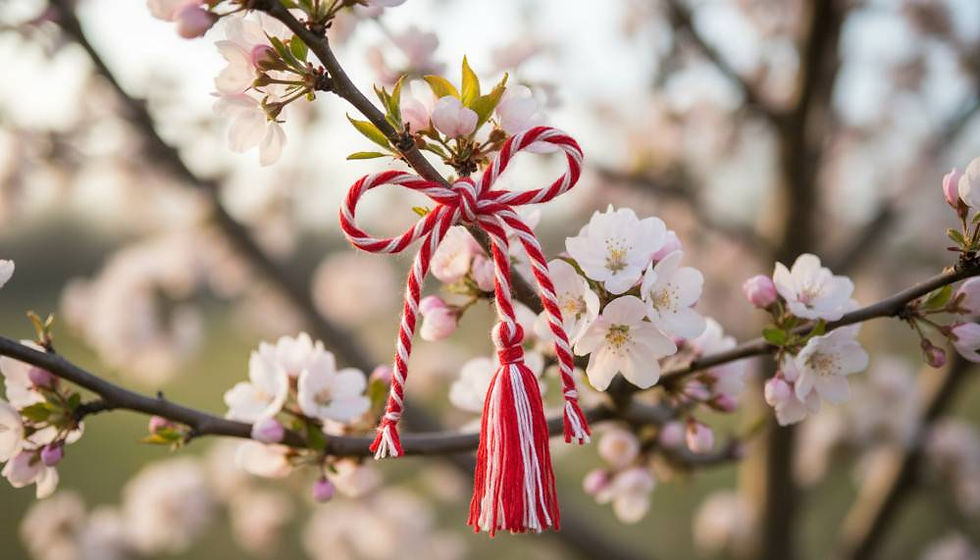
One of Bulgaria’s most beloved traditions is Baba Marta, celebrated on March 1. People exchange martenitsi, small red-and-white ornaments made of thread. They wear them on the wrist or pinned to clothing until they see a stork, a swallow, or a blossoming tree. Then they tie the martenitsa to a branch or place it under a stone, depending on local custom.
Baba Marta, whose name means Grandmother March, is imagined as a moody old woman. When she smiles, the weather warms. When she grows angry, winter returns.
The red and white threads carry layered meanings. They can suggest life and purity, blood and snow, health and renewal. The custom is simple, but its emotional pull is strong. It turns the arrival of spring into a shared act of hope.
Kukeri frighten evil with masks and bells
Kukeri rituals are among the most visually powerful traditions in Bulgaria. Participants wear large masks, fur garments, wooden frames, horns, feathers, and heavy bells. They dance through villages in winter or early spring to drive away evil spirits and invite fertility, health, and good harvests.
The sound matters as much as the sight. Bells shake the air. The dancers’ steps pound the ground. The masks can look comic, animal-like, monstrous, or majestic.
Kukeri show one of the great strengths of folklore. Fear becomes performance. The monster is not only outside the village. The villager becomes the monster for a day, then uses that wildness to protect the community.
Nestinari dance on fire
In the Strandzha region, the Nestinari tradition centers on ritual fire-dancing, connected with the feast of Saints Constantine and Helena. Dancers step barefoot onto glowing embers while carrying icons, accompanied by the beat of a drum and the sound of a gaida, the Bulgarian bagpipe.
The rite blends Christian devotion with older patterns of sacred fire, trance, healing, and protection. It is one of Bulgaria’s best-known examples of a living ritual with deep roots.
For many observers, the power of Nestinarstvo lies in its seriousness. It is not a stage trick in its traditional setting. It belongs to a sacred calendar, a community, and inherited rules.
Lazaruvane and Koleda keep the year in balance
Spring and winter customs also include Lazaruvane, when young women called lazarki visit homes, sing, and bless households before Easter. Their songs often relate to marriage, fertility, and social transition.
Around Christmas, koledari, groups of men, visit homes at night and sing ritual songs for health, prosperity, and protection. The household welcomes them with food, drink, and special breads.
These customs may seem festive, but they carry social meaning. They place each person inside the yearly cycle. Children, young adults, elders, households, animals, fields, and ancestors all have a place in the order of things.
Famous folklore figures still speak to modern imagination
Bulgarian folklore is full of memorable characters because they stand for more than one idea at a time. They entertain, teach, and challenge.
Figure | What they represent | Common story role |
Baba Marta | Renewal, mood, seasonal change | Brings spring through red-and-white martenitsi |
Samodivi | Wild beauty, danger, nature’s mystery | Enchant, punish, heal, or help heroes |
Zmey | Power, desire, storm, protection | Loves humans or defends the land |
Lamia or hala | Chaos, drought, greed, disaster | Blocks life-giving forces until defeated |
Krali Marko | Strength, justice, heroic endurance | Fights enemies and protects the oppressed |
Hitar Petar | Cleverness, humor, common sense | Outsmarts the rich, foolish, or proud |
Krali Marko carries the weight of heroic memory
Krali Marko, known across South Slavic traditions, appears in Bulgarian songs and tales as a hero of enormous strength. He rides a remarkable horse, often called Sharko, and performs feats that mix history with legend.
The historical Marko was a medieval ruler, but folklore transforms him into something larger. He becomes a defender of ordinary people, a fighter against injustice, and a figure who can survive in memory even when political realities change.
His stories matter because they preserve dignity. Under hardship, a people can keep a hero alive in song.
Hitar Petar wins with wit instead of force
Not all folklore heroes carry weapons. Hitar Petar, or Clever Peter, is a trickster figure who uses humor, quick thinking, and sharp observation. He often exposes greed, hypocrisy, or foolish pride.
Hitar Petar stories remain popular because they feel close to everyday life. He does not need magic to win. His power is intelligence, especially the intelligence of someone with less status facing someone with more.
That makes his tales deeply human. They remind listeners that laughter can be a form of justice.

Folklore shapes Bulgarian culture and identity
Folklore has helped Bulgarians preserve identity through periods of foreign rule, migration, modernization, and political change. When institutions shifted, songs, dances, rituals, and family customs kept memory alive.
This is why folklore often feels personal. A folk song may name a mountain, river, rebel, bride, mother, or harvest. A costume may show regional patterns recognizable to families from a specific area. A ritual may connect a grandparent’s village to a child living in a city.
Regional variety is central to this identity. The Rhodope Mountains, Shopluk, Thrace, Dobrudzha, Pirin, Strandzha, and other regions have distinct songs, dances, dialects, costumes, and customs. The differences do not weaken national culture. They give it depth.
Bulgarian folk music is especially famous for its uneven rhythms and powerful vocal styles. Some songs use meters that can feel surprising to listeners raised on more familiar Western patterns. The result is music that sounds both ancient and startlingly fresh.
One widely known example is “Izlel e Delyo Haydutin,” associated with the Rhodope singer Valya Balkanska. A recording of the song was included on NASA’s Voyager Golden Record, sending a piece of Bulgarian musical heritage beyond Earth. That fact has become a point of pride because it captures something true: local folklore can carry universal feeling.
Modern artists keep returning to old magic
Folklore does not survive by staying frozen. It survives because each generation finds new ways to use it.
In music, Bulgarian folk traditions have influenced choirs, composers, film scores, and experimental artists. Vocal ensembles such as those associated with the famous Bulgarian women’s choral sound brought traditional harmonies and regional songs to international audiences. The gaida, kaval, gadulka, and tapan continue to appear in both traditional performances and new arrangements.
In literature, folk motifs shape fairy-tale collections, poetry, historical fiction, and fantasy. Writers draw on samodivi, dragons, heroic songs, and village beliefs to explore memory, loss, love, and national identity. Even when a story is modern, a forest spirit or ritual calendar can give it a mythic charge.
Visual artists and designers also return to folklore. Kukeri masks inspire sculpture, illustration, fashion, and festival photography. Embroidery patterns appear in ceramics, textiles, jewelry, and graphic design. The martenitsa remains one of the clearest examples of a traditional object that still moves easily through modern life.
Cinema and theater use folklore for mood and symbolism. A fire dance, masked procession, or mountain song can suggest danger, ancestry, or transformation without long explanation.
Modern use of folklore works best when it respects the source. The strongest art does not treat tradition as decoration. It understands that every mask, song, and ritual comes from a web of belief, labor, place, and memory.

The lasting power of Bulgarian folklore
Bulgarian folklore endures because it answers needs that never fully disappear. People still want protection when life feels uncertain. They still mark spring with hope. They still tell stories about cleverness defeating arrogance and courage facing monsters.
The magic in these traditions is not only supernatural. It is also social. A village gathers, a song begins, a dancer puts on a mask, a child receives a martenitsa, and the past becomes present again.
That is the lasting cultural power of Bulgarian folklore. It keeps old voices audible without trapping them in the past. It gives Bulgaria a shared symbolic language, rich enough for myth and practical enough for daily life. Most of all, it shows how stories can protect identity, not by sealing it away, but by letting it dance, sing, and change.


Comments